

Thermal Spray Coating Materials: Complete Guide to Types, Properties & Applications (2026)
Selecting the right coating material can be the difference between a component that fails in six months and one that outlasts its uncoated counterpart three to five times over. From dense tungsten carbide for wire-drawing blocks to ceramic thermal barriers for turbine hot sections, each material family solves a different wear, heat, or corrosion problem — and no single coating does everything well.
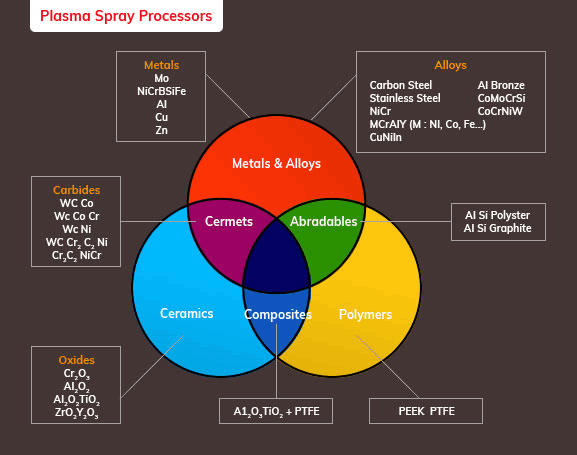
This guide breaks down the major families of thermal spray coating materials — oxide ceramics, carbides, bond coats, refractory metals, and abradables — so engineers and procurement teams can match material to application before they ever pick up the phone with a coating vendor.
What Are Thermal Spray Coating Materials?
Thermal spray coating materials are metallic, ceramic, or composite powders (or wires) that are melted and propelled at high velocity onto a component's surface, building up a dense, adherent coating layer by layer. The material chosen — not just the spray process — determines how the finished coating performs in service.
- Materials are supplied as fine powders or wires and melted using an electric arc, combustion flame, or high-velocity fuel jet, depending on the process
- Material families broadly fall into oxide ceramics, carbides, bond coats/refractory metals, and abradable seals — each suited to a different failure mode (wear, heat, corrosion, or clearance loss)
- Process and material are linked but not interchangeable: some materials are process-specific, while others can be applied through more than one route
Which process should I use for which material?
Dense wear coatings like tungsten carbide are almost always applied via HVOF coating, because its high particle velocity produces the low porosity these coatings need. Ceramic thermal barriers and insulating oxides, on the other hand, are typically applied via plasma spray coating, which reaches the extreme plume temperatures (~15,000°C) needed to melt refractory ceramics.
Is the coating material the same regardless of process used?
No. Some materials, such as yttria-stabilised zirconia thermal barriers, are essentially plasma-spray-only. Others, like WC-Co, are optimized specifically for HVOF's high-velocity, lower-temperature deposition. Choosing a material means choosing a process family at the same time.
Oxide Ceramic Coating Materials
Oxide ceramics are the workhorses of wear- and corrosion-resistant plasma spray coatings. They combine high hardness with excellent chemical stability, and unlike metallic coatings many double as electrical insulators.
Chromium Oxide (Cr₂O₃) and Alumina (Al₂O₃)
- Chromium oxide delivers 1100–1300 HV hardness, making it a go-to choice for pump seals, print/anilox rollers, and components facing severe abrasive wear
- Alumina reaches 900–1000 HV and serves a dual role: general wear resistance plus dielectric/electrical insulation on conductive parts
- Both ceramics offer strong resistance to chemical attack and corrosion in aggressive process environments
Alumina-Titania Blends
- Alumina-titania coatings sit at 700–900 HV — softer than pure alumina, but noticeably tougher and more resistant to erosion and impact
- Commonly specified for textile machinery components and pump parts subject to particle-laden flow
- A practical middle ground when a component needs erosion toughness more than raw hardness
Which ceramic coating offers the best wear resistance?
Among oxide ceramics, dense chromium oxide typically delivers the highest hardness (up to 1300 HV), making it the default choice for the most severe abrasive-wear applications.
Reader intent: Informational → Transactional
Carbide Coating Materials (Tungsten Carbide & Chrome Carbide)
When a component sees metal-on-metal wear rather than pure abrasion, carbide coatings chiefly tungsten carbide coatings — outperform oxide ceramics on both hardness and toughness.
Tungsten Carbide-Cobalt (WC-Co) Coatings
- WC-Co reaches 1100–1400 HV (roughly 70–73 HRC), among the hardest coatings achievable through thermal spray
- Bond strength exceeds 10,000 psi (ASTM C-633), and porosity stays below 1% (ASTM E-2109) — a dense, low-defect structure
- Widely specified for wire-drawing blocks, steel mill rolls (sink, hearth, bridle, deflector), and pump wear rings and plungers
When Carbide Coatings Outperform Ceramics
- Carbide coatings tolerate sliding and rolling contact far better than brittle oxide ceramics
- They retain grip and dimensional stability at elevated operating temperatures (up to 800°C on steel mill rolls)
- Post-coating diamond grinding brings finishes below 0.4 Ra for stable wire grip and precise sealing tolerances
Is tungsten carbide harder than ceramic coatings?
Generally yes — WC-Co typically reaches higher hardness (up to 1400 HV) than most oxide ceramics, along with superior toughness for metal-on-metal wear conditions like wire drawing and roll surfaces.
Reader intent: Transactional
Bond Coats, Refractory Metals & Abradable Seal Materials
Not every coating material is chosen for hardness. Some exist purely to protect the substrate or to wear away safely on purpose.
MCrAlY / NiCrAlY Bond Coats and Molybdenum
- Bond coats (250–400 HV) provide oxidation resistance and anchor an outer ceramic layer — critical in duplex thermal barrier systems
- Molybdenum is self-bonding and used on components needing anti-scuff, sliding-wear protection without a separate bond layer
- Both are typically deposited via plasma spray coating alongside the ceramic top-coat
Abradable Materials (Ni-Graphite, AlSi-Polyester)
- Intentionally soft, sacrificial coatings that abrade cleanly against rotating parts rather than damaging them
- Used to minimise tip and labyrinth clearances in compressors and turbines, directly improving efficiency
- Abradability and temperature range are tailored per application stage
Why do turbine coatings need a bond coat?
A bond coat such as MCrAlY protects the substrate from oxidation and anchors the outer ceramic thermal barrier, preventing spallation (flaking) under repeated thermal cycling — without it, the ceramic layer would fail prematurely.
Conclusion & Next Steps
Thermal spray coating materials span a wide performance spectrum — from ultra-hard tungsten carbide for metal-on-metal wear, to insulating ceramics for turbine hot sections, to soft abradables for clearance control. The right material depends on temperature, wear mode, and component geometry, not on which coating sounds toughest on a data sheet.
Not sure which material fits your application? Talk to Plasma Spray Processors' coating engineers for a material recommendation based on your operating conditions and component drawings — Request a Coating Consultation.
 +91 9820718722