
Why Industries Are Replacing Hard Chrome Plating with HVOF Tungsten Carbide Coatings
In heavy industries, metal components operate under extreme conditions. They experience constant friction, high pressure, heat, and corrosive environments. Over time, even the strongest metals start to wear down. To protect these components, industries apply surface coatings that act as a shield for the underlying metal.
For many years, hard chrome plating was the primary method for extending the lifespan of industrial parts. However, with improved technology and increasing environmental concerns, industries have begun seeking better options. As a result, today, HVOF Tungsten Carbide Coating stands out as a modern solution that delivers better durability, efficiency, and safety.
To understand this industry-wide change, it helps to examine both the problems with hard chrome plating and the benefits of newer thermal spray technologies.
Understanding Hard Chrome Plating
Hard chrome plating is a coating process in which metal components are immersed in a chemical bath containing hexavalent chromium. In an electroplating process, a chromium layer is deposited onto the component's surface.
This coating improves hardness, wear resistance, and corrosion resistance, which is why it became widely used in industries such as aerospace, oil and gas, and heavy manufacturing.
An Everyday Analogy
Consider applying a protective coating to a kitchen knife to prevent rust and keep it sharper longer. Hard chrome plating works in a similar way. It forms a metallic layer over a component to keep the underlying metal protected during operation.
While this method has served industries well for many years, it has several limitations that are increasingly hard to ignore.
Limitations of Hard Chrome Plating
Micro-Cracks and Porosity in Hard Chrome Coatings
One of the key features of hard chrome coating is the presence of micro-cracks and porosity within the coating. These tiny imperfections naturally form during the electroplating process due to internal stresses in the chromium deposit.
Micro-cracks are tiny fractures, and porosity refers to small pores in the coating. Combined, they let moisture or chemicals penetrate, reducing protection.
You can think of this like a waterproof jacket with small cracks and pores in the fabric. At first, it may still seem protective. But over time, water can seep through those openings.
When micro-cracks and pores are present in a chrome coating, they can allow corrosion to reach the base metal, reducing the coating’s effectiveness and shortening the component’s lifespan.
Thickness Limitations of Hard Chrome Plating
Hard Chrome Plating is a dipping electroplating process in which components are submerged in a chemical bath containing hexavalent chromium.
Since coating buildup is slow, making thick chrome layers is time-consuming. Double chroming, plating a part more than once, adds complexity.
Double chroming is complex, slow, and hard to control, making hard chrome plating less suitable for thick coatings.
The Rise of HVOF Tungsten Carbide Coatings
Today, many industries are switching to High Velocity Oxygen Fuel (HVOF) Coating—especially tungsten carbide varieties—because it offers a better alternative to traditional chrome plating.
In the HVOF process, oxygen and fuel are mixed and burnt to create a very hot flame. Powdered coating material, such as tungsten carbide, is sprayed into the flame and shot at the component surface at high speed.
When these particles hit the surface, they flatten and stick together, forming a dense, very tough coating.
A Simple Analogy
Think of it like painting a wall with a spray gun rather than using a brush.
When you use a brush, the paint may not spread evenly, leaving gaps or streaks. But with a spray gun, the paint is applied evenly and quickly, covering the entire surface more effectively.
HVOF similarly sprays high-speed particles onto metal, forming a strong, uniform protective layer.
Significantly Longer Component Life
One major advantage of HVOF tungsten carbide coatings is that they can extend the lifespan of industrial parts.
In many cases, these coatings last two to five times longer than traditional chrome plating. This means parts need to be replaced or repaired less often, saving industries significant money.
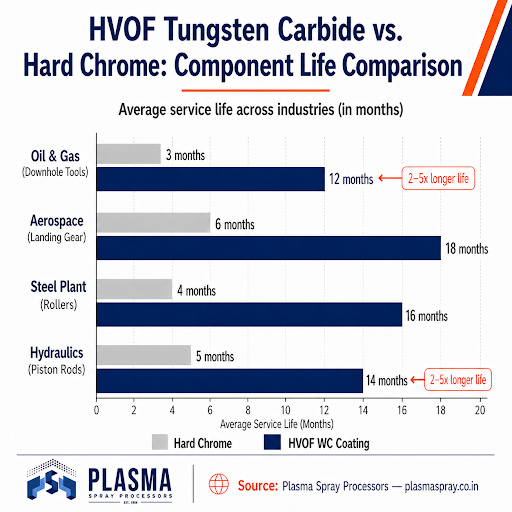
For example, downhole tools used in oil and gas drilling are subject to significant wear and pressure. Adding tungsten carbide coatings can help these tools last much longer, reducing the need to replace them as often.
In the aerospace industry, landing gear parts undergo significant stress during takeoff and landing. Advanced coatings help these parts stay reliable and resist wear over time.
Greater Flexibility in Coating Thickness
Unlike chrome plating, thermal spray methods such as HVOF and plasma spray allow you to easily select coating thicknesses.
There aren’t strict thickness limits, and coatings can be applied more quickly without complicated steps like double chroming. This makes the process faster, more reliable, and better for tough industrial jobs.
Environmental and Safety Advantages
Another major reason industries are moving away from hard chrome plating is the environmental and safety risks associated with hexavalent chromium.
Hexavalent chromium is a known carcinogen, and handling it is hazardous for workers. Because chrome plating uses chemical baths, preventing exposure is difficult.
Modern thermal spray methods provide a safer alternative.
In facilities with advanced coating systems, robots often handle the whole process. This keeps workers from coming into direct contact with dangerous materials.
Modern coating facilities also use dust collection and filtration systems. Any particles generated during the spraying process are captured and sent to approved waste management companies for recycling. This helps ensure no harmful byproducts enter the environment.
Real-World Applications of Tungsten Carbide Coatings
Tungsten carbide coatings are tough and durable, making them useful for many demanding applications.
Some common real-world uses are:
- Aircraft landing gear components that need exceptional wear resistance.
- Downhole drilling tools in the oil and gas industry operate in highly abrasive environments.
- Industrial rollers and pump components that face constant friction and pressure.
- Gas turbine components that work under high temperature and stress.
In each of these cases, advanced coating technology in India helps parts last longer and work more efficiently.
Plasma Spray Processors have significantly contributed to bringing advanced Surface Engineering Technologies to Indian industries.
With expertise in thermal spray technologies such as HVOF and plasma spray, Plasma Spray Processors offers specialised coating solutions to improve the durability and performance of industrial components.
The company focuses on applying high-performance coatings, such as tungsten carbide and other advanced materials, to help industries protect critical equipment from wear, corrosion, and extreme operating conditions.
By using modern robotic coating systems, controlled processes, and environmentally responsible waste management practices, Plasma Spray Processors ensures that its coating solutions meet both performance requirements and sustainability standards.
With these advanced technologies, the company helps industries such as oil and gas, aerospace, and heavy manufacturing extend equipment lifespans, reduce downtime, and operate more efficiently.
Conclusion
Switching from hard chrome plating to HVOF tungsten carbide coatings advances surface engineering. These coatings give improved wear resistance, longer life, higher efficiency, and safer practices.
Chrome plating has been used for years, but problems such as microcracks, porosity, thickness limitations, and environmental risks have led manufacturers to seek better options.
HVOF tungsten carbide coatings significantly extend component life and improve wear resistance, making processes more efficient and reliable. For applications where a more economical option is required, chrome carbide coatings can also be used as a cost-effective solution while still providing strong protection against wear.
As industries increasingly prioritise performance and sustainability, advanced coating technologies are becoming the preferred choice for protecting critical equipment. Plasma Spray Processors is helping drive this transition by delivering advanced surface-engineering solutions that improve productivity, reliability, and lifespan.
 +91 9820718722