

Tungsten Carbide Coating Specification: A Buyer's Guide to Hardness, Bond Strength & Standards
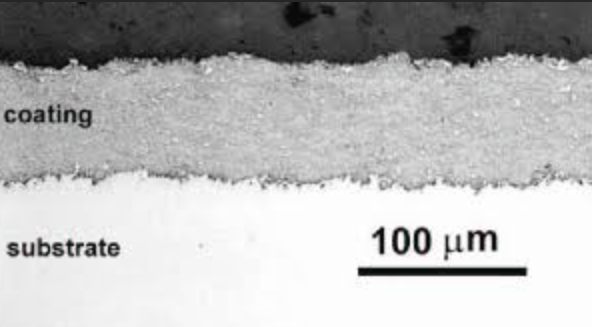
When a purchase order calls for “tungsten carbide coating,” the specification behind those three words determines whether a component survives one year or five. Hardness range, bond strength, porosity limits, and the applicable ASTM standards all need to be nailed down before RFQs go out — otherwise vendors quote apples-to-oranges coatings.
This guide walks through how to read, write, and verify a tungsten carbide coatings (WC-Co) specification, using the benchmarks industrial buyers should expect from a qualified HVOF applicator.
Core Specification Parameters for Tungsten Carbide Coatings
Hardness Range (HV/HRC)
- Industry-grade WC-Co coatings typically specify 1100–1400 HV, equivalent to roughly 70–73 HRC
- Higher hardness generally means better resistance to sliding and abrasive wear, but toughness and application fit matter just as much as the raw number
- Always confirm whether the quoted hardness is coating-only or measured through a cross-section, since test method affects the reported value
Bond Strength and Porosity Limits
- Bond strength should exceed 10,000 psi per ASTM C-633 — this determines resistance to delamination under load
- Porosity should be held below 1% per ASTM E-2109 for dense, homogeneous coverage with minimal weak points
- A spec that omits either figure leaves room for vendors to quote a technically “tungsten carbide” coating that performs very differently in service
What hardness should I specify for a tungsten carbide coating?
For wear applications like wire-drawing blocks or rolls, 1100–1400 HV (70–73 HRC) is the standard benchmark range.
Governing Standards & Test Methods
Tungsten carbide is almost always deposited by HVOF coating, so it's worth knowing which test methods that process is measured against before you finalize a spec.
ASTM C-633 (Bond Strength) and ASTM E-2109 (Porosity)
- Specify which ASTM methods the vendor tests against, not just pass/fail claims on a data sheet
- ASTM C-633 measures adhesive/cohesive bond strength via a pull-test; ASTM E-2109 quantifies porosity through image analysis of a polished cross-section
- Both should be traceable to a specific test report, not a generic claim of “industry standard quality”
What to Request in a Coating Inspection Report
- Request microstructure and bond-strength data from an in-house QC lab, ideally with photos of the polished cross-section
- Surface finish specs (e.g., below 0.4 Ra) should be called out separately from coating hardness — they're independent parameters
- For critical components, ask whether the vendor can provide batch-level or component-level traceability
Do I need third-party certification for coating tests, or is in-house QC sufficient?
Many industrial buyers accept a qualified applicator's in-house QC lab data (microstructure + bond strength) as sufficient, provided methods are traceable to ASTM standards; third-party verification can be requested for critical components.
Writing a Coating Spec for Your Component
Application-Specific Specification Examples
- Wire-drawing blocks (250–1400mm): typically specify WC-Co at 1100–1400 HV with a ground finish for stable wire grip
- Steel mill rolls (sink, hearth, bridle, deflector): often need WC-modified coatings rated for continuous service up to 800°C
- Pump components (wear rings, plungers): pair hardness specs with precision-ground dimensional tolerances for erosive, high-cycle service
Dimensional and Finish Tolerances Alongside Hardness Specs
- State the target coating thickness range — too thin risks breakthrough wear, too thick risks residual stress and cracking
- Call out post-coating grinding tolerances and surface finish (Ra) explicitly, since these affect fit as much as wear life
- Note whether the substrate is induction-hardened or through-hardened, since WC-Co coatings can be applied over both without compromising the base heat treatment
Can tungsten carbide coatings be applied over hardened substrates?
Yes — WC-Co coatings can be applied on top of induction-hardened or through-hardened components, adding a wear layer without compromising the base heat treatment.(upto 55 HRC)
Common Specification Mistakes to Avoid
Under-Specifying Porosity or Bond Strength
- Specifying only “tungsten carbide coating” without hardness/porosity invites inconsistent, non-comparable quotes
- Leaving out the ASTM method reference makes it hard to hold a vendor accountable after the fact
- A spec without abrasion resistance context leaves the coating's fitness for purpose ambiguous — always tie hardness back to the wear mode the component actually experiences
Ignoring Service Temperature Limits
- Failing to state service temperature can lead to a coating selection unsuitable for the application — WC-Co has practical upper temperature limits compared with ceramic alternatives
- Not requesting minimum order quantity (MOQ) or warranty terms upfront can create surprises later in the procurement cycle
- Most qualified applicators offer an MOQ of 1 piece and 6–12 month workmanship warranties — confirm both before finalizing the spec
What warranty is standard for tungsten carbide coatings?
A 6–12 month warranty against workmanship and manufacturing defects from installation or supply is a common industry benchmark.
Conclusion & Next Steps
A tungsten carbide coating specification is only as good as the numbers behind it — hardness, bond strength, porosity, and the ASTM methods used to verify them. Buyers who specify precisely, including the abrasion resistance behaviour their component actually needs, get comparable quotes and predictable performance. The same discipline applies across the wider range of thermal spray coating materials a component might need — tungsten carbide is one option among several.
Need help drafting a coating specification for your component? Send Plasma Spray Processors your drawing and operating conditions for a tailored WC-Co spec recommendation — Get a Specification Review.
 +91 9820718722